
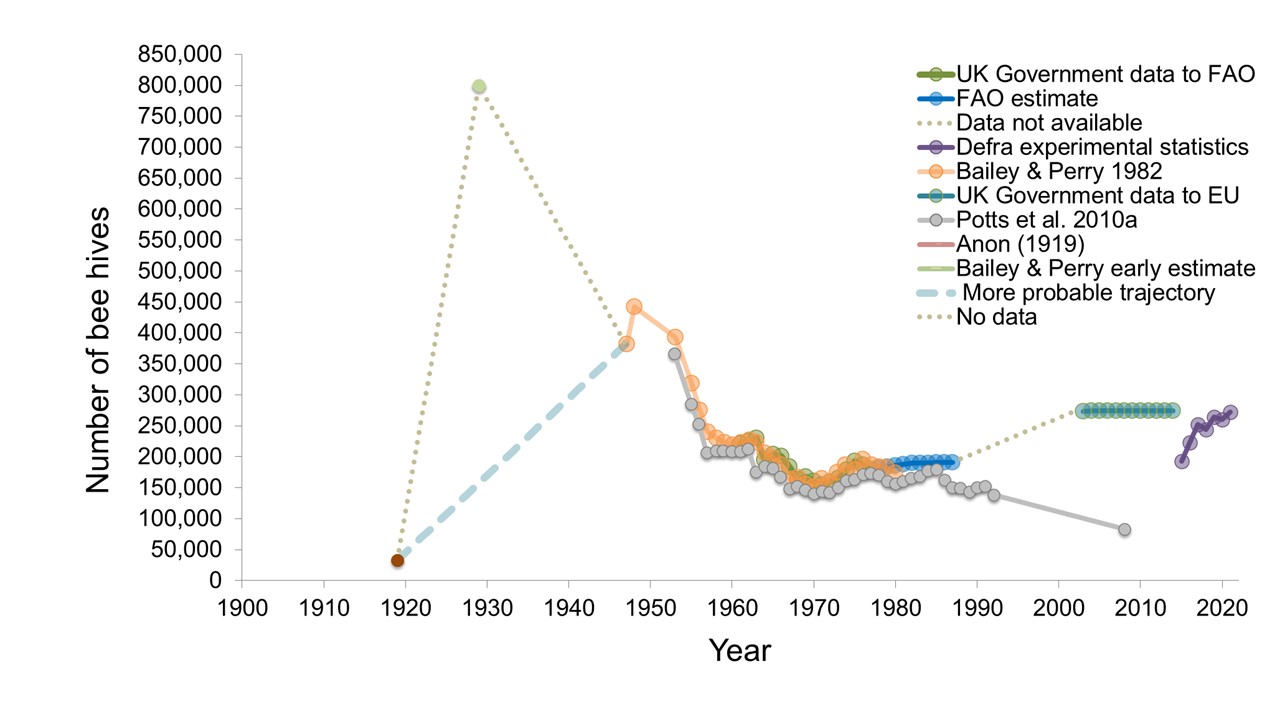
If you’ve read my book Pollinators & Pollination: Nature and Society you’ll know that I have a section in the chapter “The shifting fates of pollinators” that deals with the honey bee situation. In that section I bring together the most comprehensive data set so far available on changes in number of hives in Britain. It’s based on a couple of earlier blog posts and if you’ve not read my book take a look at this one first and then this one to give you some context and more information about the sources of the data.
So far this year I have had several requests from people for the original data (which I’m happy to supply) and queries about what it means. So I thought that the time was right to update the graph with the latest official government figures from BeeBase.
The graph above brings the story up to 2021 where the official estimated number of hives is 272,631. That’s an increase of more than 40% since the first BeeBase estimate in 2015.
The take home from this figure is that the current number of honey bee hives in Britain is similar to what it was in the mid-1950s.
So the answer to the question “have honey bees declined in Britain?” is a resounding NO! They are at least as abundant as they were almost 70 years ago. This reflects the global situation where there’s been a substantial increase in hive numbers since the 1960s, as you can see in the figure below.

So if you want to “Save the Bees” or otherwise support pollinators, please focus on the wild, unmanaged species rather than the managed Western Honeybee (Apis mellifera). As always, comments and questions are welcome below or send me a message via my Contact page.
 Prof. Jeff Ollerton - ecological scientist and author
Great post, Jeff, thank you. Is there an estimate of feral honey bee colonies out there?
Thanks Mariano. Unfortunately not, but in my experience wild/feral honey bee colonies are not uncommon in Britain.
My garden seems deficient in pollinators this year – particularly the teasel plants which are now flowering but hardly have a bee on them. It’s not scientific, but it is noticeable.
Great to see this in such detail. I’m also confused, the graph seems to indicate that the estimates for the 1950’s are about 350-450k, which is 30-65% higher than the 272k in 2021. What am I missing? Best wishes, Christoph
Thanks Christoph. The estimate for 1956 is 274,915 hives, which is what my comparison was based on. Prior to that the numbers are higher, as you indicate.
Pingback: Which honeybees are declining and which are not? | Prof. Jeff Ollerton – ecological scientist and author
Have you done comparable graphs of yield per hive, and number of flower species identifiable in the honey, over time too? I suppose it’s mostly rape here in the UK?
Some idea of the replacement rate of hives necessary to keep up the numbers might be a better indicator of problems than the actual numbers of hives. perhaps?
Those sorts of data are just not available at a national scale. It’s shocking how little we know about trends in beekeeping in Britain.
Pingback: Have we passed “peak honey bee” in Britain? An update of hive numbers for World Bee Day 2025 | Prof. Jeff Ollerton – ecological scientist and author