

It’s been quite a while since I posted about the Chequered Skipper Reintroduction Project – see my earlier posts here and here. But my involvement has continued, albeit geographically removed from Northamptonshire, and I thought I’d give a brief update with two good news stories.
The headline story is, of course, the success of the project. Since its reintroduction in summer 2018, the Chequered Skipper population has thrived and grown and is now the first self-sustaining population in England since it went extinct there in 1976. Not only that, but the management within Rockingham Forest that was designed to improve the habitat for this butterfly has also benefitted a range of other species, including plants, insects and birds.
How do we know this? Well, the situation on the ground is being intensively monitored by the project team and the passionate volunteers who are helping to count butterflies and other species every year. The data collected from these activities has fed into Jamie Wildman’s PhD thesis where he’s collated and analysed the results. And that’s the second item of good news: yesterday Jamie successfully defended his PhD thesis and was awarded a pass with very minor corrections!
I’m actually not surprised because it’s a great thesis with some fascinating results that not only document this reintroduction but also rewrite the history of the decline and extinction of the English populations of Chequered Skipper. The first paper from that is out – see this post – and there’s more to follow shortly.
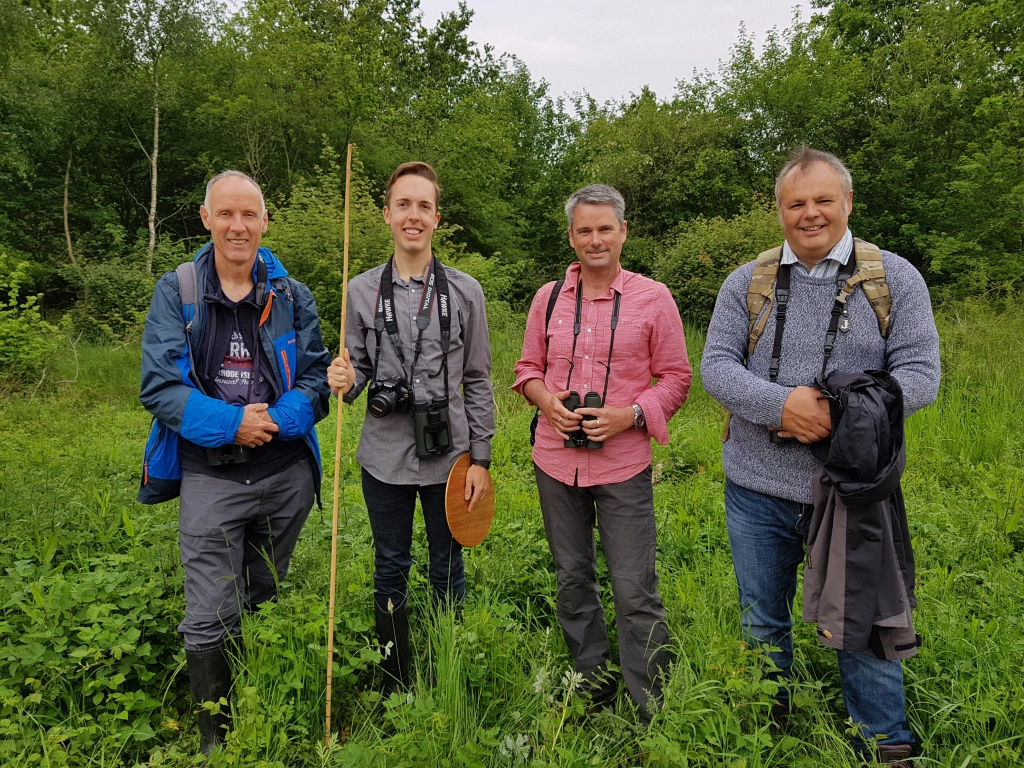
Once again, huge congratulations to Jamie and thanks to the project team and the other supervisors for their hard work. Here’s my favourite photo of Jamie, second from the left and just starting out on his PhD journey back in 2018.
 Prof. Jeff Ollerton - ecological scientist and author
Nice work there. Was anything done to immediately improve the direct environment for the skipper before introduction? I’d like to use the story as an example in my course on ecology for landscape planners, where students will introduce species specific improvement of landscapes to benefit a focus species (and ideally others with it).
Hi Robin – yes, there was a couple of years of management to the forest before the reintroduction happened, particularly widening rides between blocks of woodland – there’s more information here: https://naturebftb.co.uk/wp-content/uploads/2022/01/Chequered-Skipper-BftB.pdf
Thanks Jeff. I will certainly look into it. I think nature conservation can be pretty abstract for landscape planners – and who doesn’t love a success story?
Pingback: Using photographic mark-recapture to estimate population size, movement, and lifespan of a reintroduced butterfly – new study just published | Prof. Jeff Ollerton – ecological scientist and author